> ## Documentation Index
> Fetch the complete documentation index at: https://docs.noisemaker.dev/llms.txt
> Use this file to discover all available pages before exploring further.
# Credits and billing
> Follow the integer ledger from top-up through reservation, provider calls, and settlement.
 All balances and charges use integer micro-USD. One US dollar is exactly 1,000,000 micro-USD. The pricing snapshot records a version and
 surplusBps. Provider decimal costs round up to micro-USD, the configured surplus is applied, and the result rounds up again before it enters the ledger.
## Account and balance
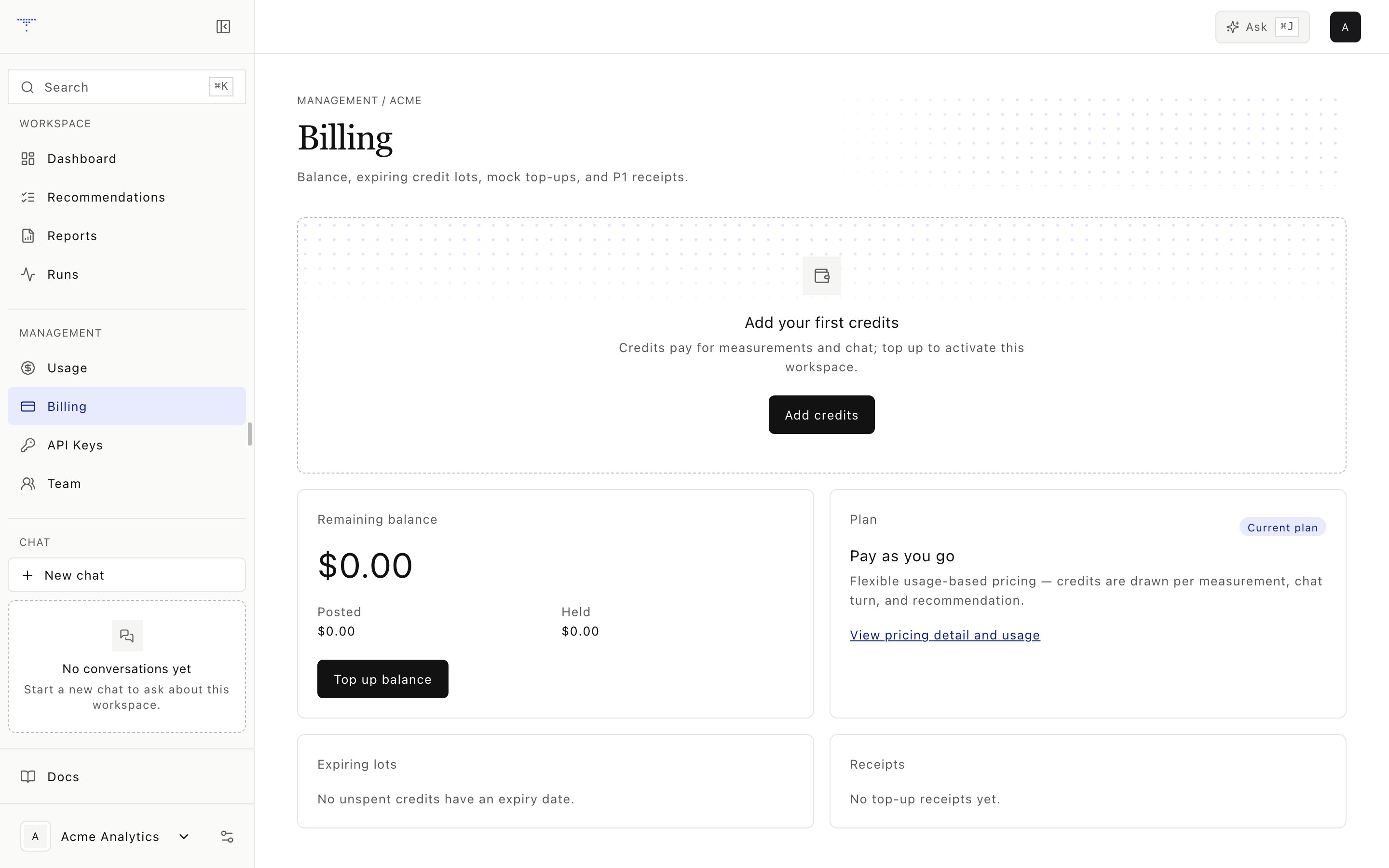
A credit account can be active, frozen, or closed. Its summary separates:
| Value | Meaning |
| ----------- | ------------------------------------------ |
| Posted | Net amount committed to the ledger |
| Held | Amount reserved for active operations |
| Available | Spendable amount after holds |
| Next expiry | Earliest future expiry among positive lots |
## Ledger entries
The append-only ledger uses:
| Type | Effect |
| ----------------------- | ------------------------------------ |
| topup | Add purchased or mocked local credit |
| grant | Add granted credit |
| debit | Charge an operation |
| refund | Return credit |
| expiry | Remove unused expired credit |
| adjustment | Record an authorized correction |
Positive entries create lots. Consumption uses the earliest expiry first, then creation and identifier order. Active holds take priority over expiry. An expiry job debits only the unused remainder.
## Metered operation
The service hashes the request inputs and resolves the operation identity.
The estimate is held across available lots. Insufficient balance returns HTTP 402 with required and available amounts.
The worker receives a signed operation token and an active budget lease.
Before every paid provider call, the worker asks the lease to authorize the next amount.
Provider usage becomes an idempotent cost event under the operation.
The manifest is sealed, actual cost is debited, and unused holds return to the lots.
## Reservations and leases
Reservation and lease lifetimes come from versioned pricing configuration. Heartbeats extend an active lease within that contract. Expiry sweeps revoke abandoned leases and reconcile their operation.
If a lease cannot be extended or cannot authorize the next call, the worker stops before making that call. This is the zero-stop rule.
A provider call already authorized and sent can still be charged even if the surrounding job is cancelled afterward.
## Top-up
The current top-up endpoint is explicitly a mock. It is session-only, requires credits:topup, accepts a positive integer micro-USD amount, and uses an idempotency key. The Billing UI offers \$25 by default to an authorized owner.
Do not describe this endpoint as a production payment processor.
## Usage ledger
Usage combines ledger entries with operation manifests. The API defaults to 100 records and caps limit at 500. The current UI requests up to 500 and paginates 25 rows at a time in the browser.
Use the operation identifier to reconcile:
```text theme={null}
reservation -> lease authorizations -> cost events -> manifest -> debit
```
## Expiry behavior
A hold can temporarily protect a lot from expiring. Settlement returns unused funds to their original lots, where normal expiry applies. Check nextExpiryAt before launching a large operation against short-lived grants.