> ## Documentation Index
> Fetch the complete documentation index at: https://docs.noisemaker.dev/llms.txt
> Use this file to discover all available pages before exploring further.
# Platform overview
> Measure how a brand appears in search and AI answers, then turn the evidence into reviewed work.
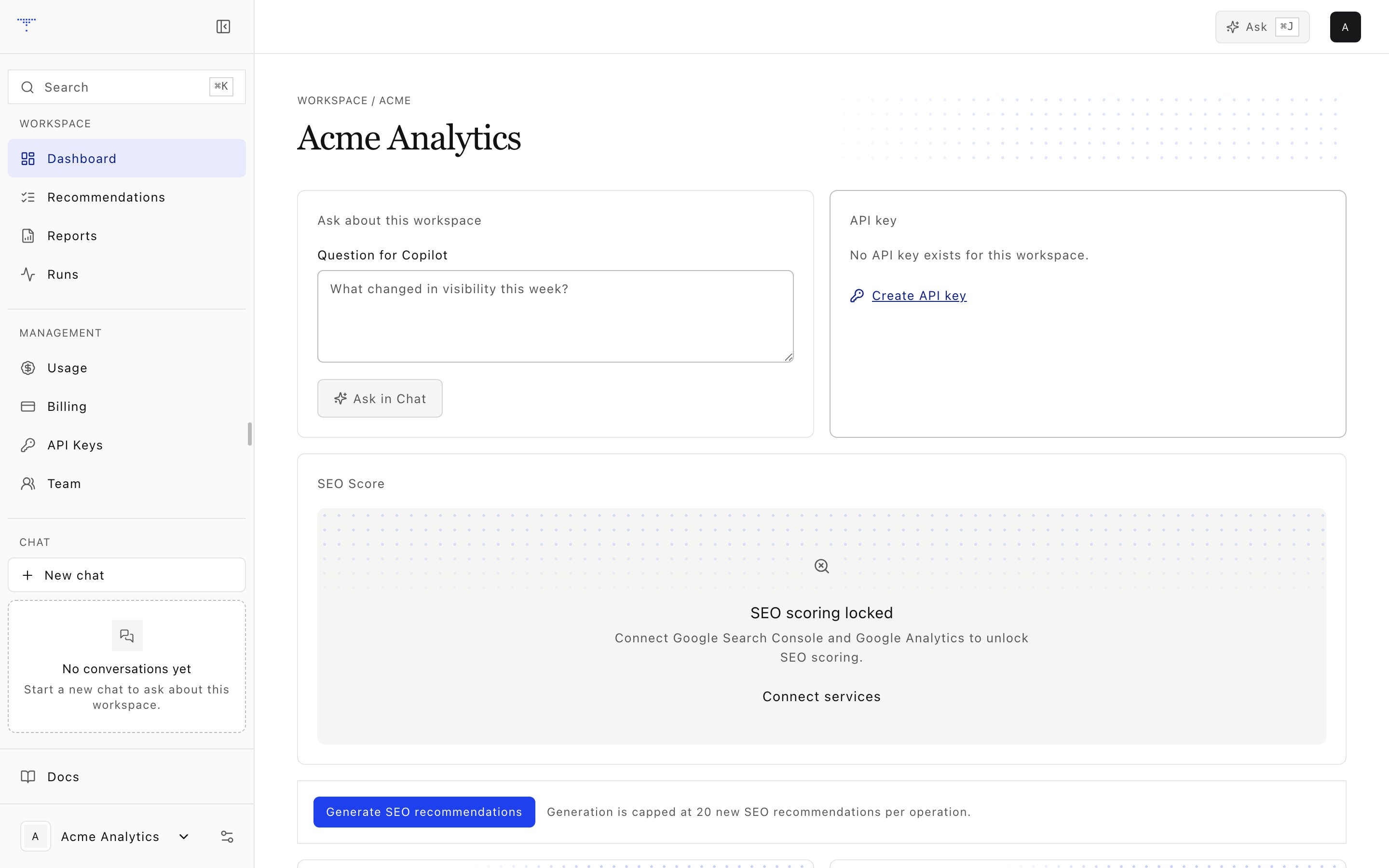 The platform measures two related surfaces:
* **SEO** tracks search demand, traffic, authority, content coverage, and technical health.
* **GEO** tracks whether AI answer engines mention, position, describe, and cite a brand.
It keeps the source evidence behind each score. A team can inspect provider responses, search and analytics signals, research artifacts, technical checks, and the recommendation history before acting.
Configure operator credentials, create a workspace, and run the first measurement.
Understand workspaces, runs, signals, artifacts, credits, and operations.
See how the SEO and GEO views differ and where their evidence comes from.
Choose session or bearer authentication and check the scope for each route group.
## How work moves through the product
A measurement run queries the configured AI engines. SEO processing reads provider-local search, analytics, authority, and audit signals. Research runs build frozen artifacts from the workspace profile and available sources.
Versioned formulas produce the score snapshots. Canonical input digests make SEO processing and report creation replay-safe.
The platform ranks evidence-backed SEO and GEO recommendations. Generated copy is stored as an immutable draft with provenance and validation steps.
A recommendation moves through a fixed lifecycle. Compliance work cannot skip review evidence. Every state change is appended to the history.
## Product boundaries
The application does not edit a customer site, publish content, or grant itself access to analytics properties. People remain responsible for implementation, access invitations, review, and verification.
OpenRouter, Exa, AgentMail, and PageSpeed credentials are operator-owned secrets. GA4 and Google Search Console access is granted per workspace to its provisioned AgentMail address. See [Connections](/connections) for the custody model.
A missing signal is not silently treated as a zero. Score formulas drop unavailable components and re-normalize the available weight where the relevant contract permits it.
## Where to go next
* New operator: [Local quickstart](/quickstart)
* New teammate: [Core concepts](/concepts) and [Dashboard](/dashboard)
* Content or search owner: [Prompts](/prompts), [Research pipeline](/research), and [Recommendations](/recommendations)
* Platform operator: [Deployment](/operations/deployment), [Data model](/operations/data-model), and [Credits and billing](/credits-billing)
The platform measures two related surfaces:
* **SEO** tracks search demand, traffic, authority, content coverage, and technical health.
* **GEO** tracks whether AI answer engines mention, position, describe, and cite a brand.
It keeps the source evidence behind each score. A team can inspect provider responses, search and analytics signals, research artifacts, technical checks, and the recommendation history before acting.
Configure operator credentials, create a workspace, and run the first measurement.
Understand workspaces, runs, signals, artifacts, credits, and operations.
See how the SEO and GEO views differ and where their evidence comes from.
Choose session or bearer authentication and check the scope for each route group.
## How work moves through the product
A measurement run queries the configured AI engines. SEO processing reads provider-local search, analytics, authority, and audit signals. Research runs build frozen artifacts from the workspace profile and available sources.
Versioned formulas produce the score snapshots. Canonical input digests make SEO processing and report creation replay-safe.
The platform ranks evidence-backed SEO and GEO recommendations. Generated copy is stored as an immutable draft with provenance and validation steps.
A recommendation moves through a fixed lifecycle. Compliance work cannot skip review evidence. Every state change is appended to the history.
## Product boundaries
The application does not edit a customer site, publish content, or grant itself access to analytics properties. People remain responsible for implementation, access invitations, review, and verification.
OpenRouter, Exa, AgentMail, and PageSpeed credentials are operator-owned secrets. GA4 and Google Search Console access is granted per workspace to its provisioned AgentMail address. See [Connections](/connections) for the custody model.
A missing signal is not silently treated as a zero. Score formulas drop unavailable components and re-normalize the available weight where the relevant contract permits it.
## Where to go next
* New operator: [Local quickstart](/quickstart)
* New teammate: [Core concepts](/concepts) and [Dashboard](/dashboard)
* Content or search owner: [Prompts](/prompts), [Research pipeline](/research), and [Recommendations](/recommendations)
* Platform operator: [Deployment](/operations/deployment), [Data model](/operations/data-model), and [Credits and billing](/credits-billing)