> ## Documentation Index
> Fetch the complete documentation index at: https://docs.noisemaker.dev/llms.txt
> Use this file to discover all available pages before exploring further.
# Reports
> Understand report taxonomy, frozen snapshots, and the weekly operating report.
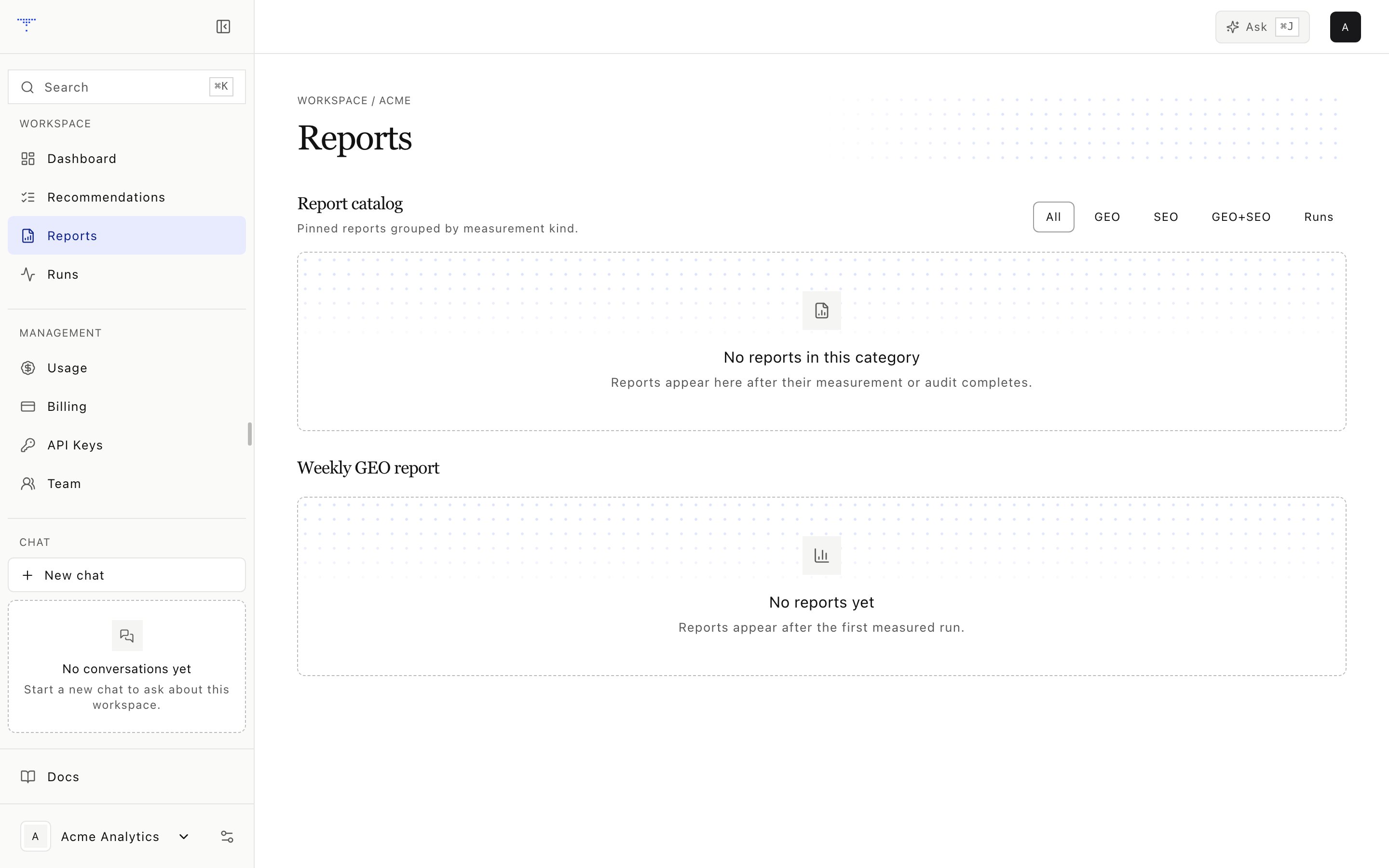 Reports preserve a readable result together with the score and evidence snapshots used to build it.
## Catalog taxonomy
| Kind | Contents |
| --------------------------------- | --------------------------------------------- |
|
Reports preserve a readable result together with the score and evidence snapshots used to build it.
## Catalog taxonomy
| Kind | Contents |
| --------------------------------- | --------------------------------------------- |
| geo | GEO scorecard and visibility evidence |
| seo | SEO score and component snapshot |
| GEO + SEO (combined) | Available SEO and GEO snapshots in one report |
| run | Evidence tied to a specific measurement run |
A run report requires a run identifier. GEO is frozen for every catalog report. SEO is frozen for SEO and combined reports, and can be included in a run report.
## Unavailable scores
If a requested score does not exist, the report stores an explicit unavailable row with its version and reason. It does not write a numeric zero.
Report identifiers and digests are deterministic. Building the same report from the same canonical inputs returns the same catalog identity.
## Weekly report
The weekly pipeline writes:
```text theme={null}
data/reports//-W.md
```
Its operating sections include:
* Current and previous scorecards
* Up to ten eligible recommendations
* Gaps that persisted for at least two evidence weeks
* A separate compliance review section
* Evidence references used by the report
The daily maintenance path can refresh lifecycle evidence and create the weekly file. It does not create a new recommendation set through the P2 generation path.
## Legacy files
The report service can also index existing JSON and Markdown report files. It derives a stable identity from their header, run reference, and file metadata. Older scoreboard and competitor links remain available when their source file contains them.
## Reading a report
A run report and a combined report answer different questions.
An unavailable score is a data gap, not poor performance.
Follow run, signal, audit, and recommendation references before assigning a cause.
Keep formula versions, provider-local dates, and engine registry versions aligned.